31 May 2026
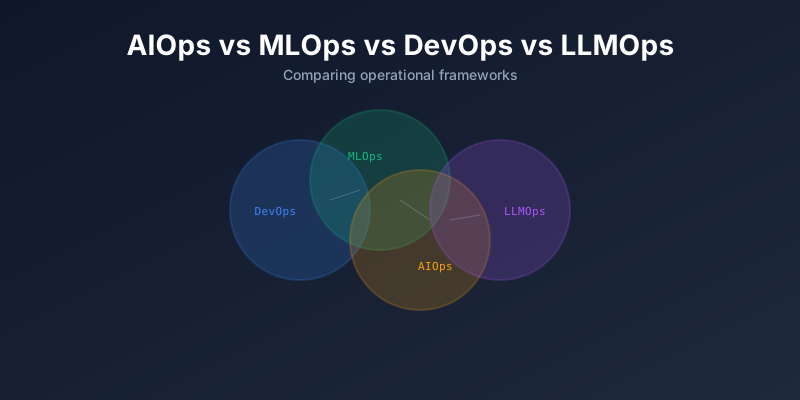
AIOps vs MLOps vs DevOps vs LLMOps
A clear comparison of AIOps, MLOps, DevOps, and LLMOps — what each one does and how they relate to each other.
As AI becomes part of software delivery, new “Ops” disciplines have emerged. Here is a clear breakdown of each one.
Overview
DevOps ──────────────── Software delivery
  │
  ├── MLOps ─────────── Machine Learning models
  │     │
  │     └── LLMOps ──── Large Language Models
  │
  └── AIOps ─────────── AI for IT operations
DevOps
What: Practices and tools to deliver software faster and more reliably.
Focus: Automate the full software lifecycle — build, test, deploy, monitor.
Key practices:
- CI/CD pipelines (GitHub Actions, Jenkins, GitLab CI)
- Infrastructure as Code (Terraform, Pulumi)
- Containerization (Docker, Kubernetes)
- Monitoring and observability (Prometheus, Grafana)
- Collaboration between dev and ops teams
Code → Build → Test → Deploy → Monitor → Feedback
  ↑___________________________________________|
MLOps
What: DevOps principles applied to Machine Learning systems.
Focus: Deploy, monitor, and maintain ML models in production. This is where most of the real work happens — not in model training.
Key practices:
- Experiment tracking (MLflow, Weights & Biases)
- Model versioning and registry
- Data versioning (DVC)
- Automated training pipelines
- Model serving (TensorFlow Serving, Triton)
- Model monitoring (data drift, performance decay)
- Feature stores
Data → Train → Evaluate → Deploy → Monitor → Retrain
  ↑______________________________________________|
Tools: MLflow, Kubeflow, Seldon, BentoML, SageMaker
LLMOps
What: MLOps specialized for Large Language Models.
Focus: Managing the unique challenges of LLMs — they are expensive, hard to evaluate, and change behavior with prompts.
Key practices:
- Prompt management and versioning
- RAG (Retrieval-Augmented Generation) pipelines
- Fine-tuning workflows
- Token cost tracking and optimization
- Guardrails and safety filters
- Evaluation frameworks (human + automated)
- Vector database management
How it differs from MLOps:
| Aspect | MLOps | LLMOps |
|---|---|---|
| Training | Full model training | Fine-tuning or prompt engineering |
| Data | Structured datasets | Documents, embeddings |
| Evaluation | Metrics (accuracy, F1) | Hard to measure (human eval) |
| Cost | Compute for training | Token usage per request |
| Versioning | Model weights | Prompts + model versions |
Tools: LangChain, LlamaIndex, Weights & Biases, Guardrails AI, vLLM
AIOps
What: Using AI/ML to improve IT operations.
Focus: Apply machine learning to monitoring data to detect anomalies, predict incidents, and automate responses.
Key practices:
- Anomaly detection in logs and metrics
- Predictive alerting (before issues happen)
- Automated incident response
- Log analysis and pattern recognition
- Noise reduction in alerts
- Root cause analysis
Direction: AIOps uses AI to help operations, while MLOps/LLMOps are operations for AI.
AIOps:  AI → helps → IT Operations
MLOps:  IT Operations → helps → AI/ML
Comparison Table
| DevOps | MLOps | LLMOps | AIOps | |
|---|---|---|---|---|
| Goal | Ship software | Ship ML models | Ship LLM apps | Smarter IT ops |
| Input | Code | Code + Data | Prompts + Docs | Logs + Metrics |
| Output | Running app | Predictions | Text/responses | Insights/alerts |
| CI/CD | Build & deploy | Train & deploy | Prompt & deploy | N/A |
| Monitor | Uptime, errors | Data drift | Quality, cost | Anomalies |
How They Connect
All of these share common foundations:
- Automation — reduce manual work
- Monitoring — know when things break
- Versioning — track what changed
- Reproducibility — recreate any state
- Collaboration — teams work together
In practice, a modern AI product uses all of them: DevOps for the application, MLOps for the models, LLMOps for the LLM features, and AIOps to keep everything running.