31 May 2026
Big O Notation, Data Structures, and Concurrency
A practical guide to Big O notation, common data structures, and concurrency basics for software engineers.
Understanding time complexity, data structures, and concurrency are fundamental skills for any software engineer.
Big O Notation
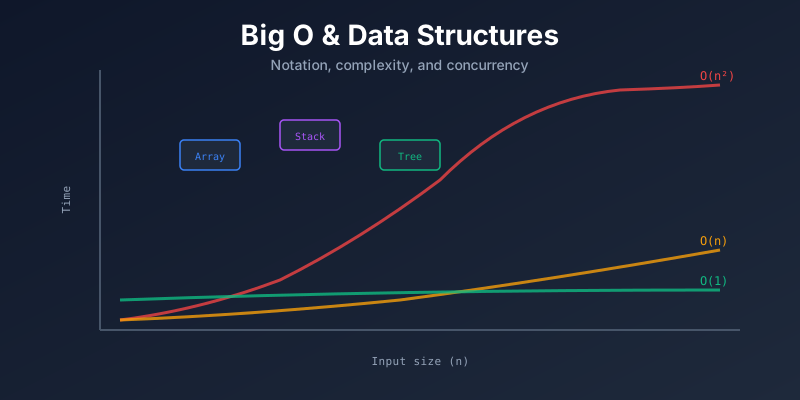
Big O describes how an algorithm’s performance scales as input grows.
Common Complexities
| Big O | Name | Example |
|---|---|---|
| O(1) | Constant | Access array by index |
| O(log n) | Logarithmic | Binary search |
| O(n) | Linear | Loop through array |
| O(n log n) | Linearithmic | Merge sort, quick sort |
| O(n²) | Quadratic | Nested loops |
| O(2ⁿ) | Exponential | Recursive Fibonacci |
Time
 ↑
 │         O(2ⁿ)  /
 │              /
 │    O(n²)  /
 │         /
 │  O(n log n)
 │    O(n) ──────
 │  O(log n) ───
 │  O(1) ────────
 └──────────────→ Input size (n)
Rules
- Drop constants: O(2n) → O(n)
- Drop lower terms: O(n² + n) → O(n²)
- Focus on worst case
Data Structures
Arrays / Lists
arr = [10, 20, 30, 40, 50]| Operation | Time |
|---|---|
| Access by index | O(1) |
| Search | O(n) |
| Insert at end | O(1) |
| Insert at start | O(n) |
| Delete | O(n) |
Linked Lists
Each node points to the next.
[10] → [20] → [30] → [40] → None| Operation | Time |
|---|---|
| Access by index | O(n) |
| Insert at start | O(1) |
| Insert at end | O(n) or O(1) with tail |
| Delete | O(n) |
Stacks (LIFO)
stack = []
stack.append(1)   # push
stack.append(2)
stack.pop()       # returns 2
Use cases: Undo operations, function call stack, parsing.
Queues (FIFO)
from collections import deque
queue = deque()
queue.append(1)    # enqueue
queue.popleft()    # dequeue
Use cases: Task scheduling, BFS, message queues.
Hash Maps / Dictionaries
cache = {"user:1": "Alice", "user:2": "Bob"}| Operation | Average | Worst |
|---|---|---|
| Get | O(1) | O(n) |
| Set | O(1) | O(n) |
| Delete | O(1) | O(n) |
How it works: A hash function maps keys to array indices. Collisions are handled by chaining or open addressing.
Trees
Binary Search Tree (BST)
        8
       / \
      3   10
     / \    \
1 6 14| Operation | Average | Worst |
|---|---|---|
| Search | O(log n) | O(n) |
| Insert | O(log n) | O(n) |
| Delete | O(log n) | O(n) |
Balanced Trees (AVL, Red-Black)
Self-balancing → always O(log n) operations.
Heaps
A complete binary tree where parent is always smaller (min-heap) or larger (max-heap).
import heapq
heap = []
heapq.heappush(heap, 3)
heapq.heappush(heap, 1)
heapq.heappop(heap)  # returns 1 (smallest)
Use cases: Priority queues, top-K problems.
Graphs
Nodes connected by edges.
# Adjacency list
graph = {
    "A": ["B", "C"],
    "B": ["A", "D"],
    "C": ["A"],
    "D": ["B"],
}
Algorithms: BFS (shortest path), DFS (explore all), Dijkstra (weighted paths).
Hashing
Hash Functions
Map data of any size to a fixed-size value:
hash("hello") # → integerProperties:
- Same input → same output (deterministic)
- Small change in input → very different output
- Fast to compute
Use cases: Dictionaries, caches, checksums, password storage.
Concurrency
Key Concepts
| Term | Meaning |
|---|---|
| Concurrency | Multiple tasks make progress (not necessarily at the same time) |
| Parallelism | Multiple tasks run at the exact same time (multiple CPUs) |
| Thread | Lightweight unit of execution within a process |
| Process | Independent program with its own memory |
| Race condition | Bug from unsynchronized shared data access |
| Deadlock | Two threads each waiting for the other |
Python Concurrency
# Threading — good for I/O-bound tasks
import threading

def fetch_data(url):
    response = requests.get(url)
    return response.json()

threads = [threading.Thread(target=fetch_data, args=(url,))
           for url in urls]
for t in threads: t.start()
for t in threads: t.join()

# Multiprocessing — good for CPU-bound tasks
from multiprocessing import Pool

with Pool(4) as p:
    results = p.map(process_item, items)

# Async — good for many I/O operations
import asyncio

async def fetch(url):
    async with aiohttp.ClientSession() as session:
        async with session.get(url) as resp:
            return await resp.json()

results = asyncio.run(asyncio.gather(*[fetch(u) for u in urls]))
When to Use What
| Approach | Best For | Python GIL? |
|---|---|---|
| Threading | I/O-bound (network, files) | Limited by GIL |
| Multiprocessing | CPU-bound (computation) | Bypasses GIL |
| Async | Many I/O operations | Single thread, no GIL issue |
Summary
| Topic | Key Takeaway |
|---|---|
| Big O | Measure how code scales, not how fast it runs |
| Arrays | Fast access, slow insert/delete |
| Hash Maps | O(1) average lookup — the most used data structure |
| Trees | O(log n) for sorted data |
| Concurrency | Use threads for I/O, processes for CPU, async for many connections |