31 May 2026
Database Design and Data Modeling
Normalized vs denormalized schemas, relational modeling, and when to use each approach.
Data Software
Database Data Modeling SQL Normalization
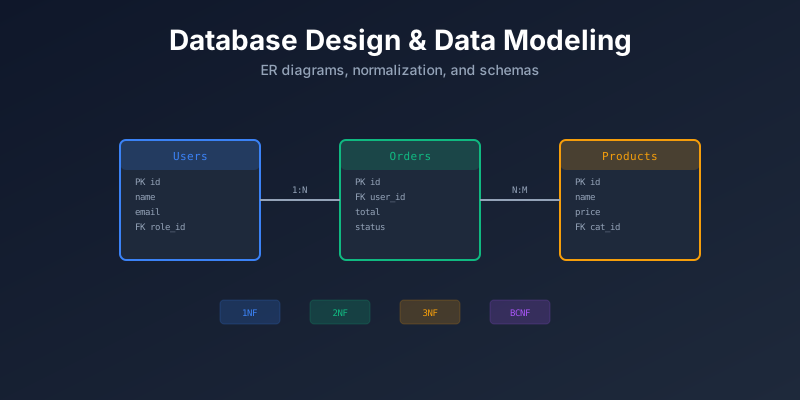
Good database design is the foundation of any reliable system. Understanding normalization and denormalization helps you make the right trade-offs.
Normalized vs Denormalized
| Aspect | Normalized | Denormalized |
|---|---|---|
| Data duplication | No redundancy | Intentional redundancy |
| Write performance | Fast writes | Slower writes |
| Read performance | Needs JOINs (slower) | Fast reads (no JOINs) |
| Consistency | Easy to maintain | Risk of inconsistency |
| Use case | OLTP (transactional) | OLAP (analytical) |
Normalization
Normalization organizes data to reduce redundancy. Each level is called a “Normal Form.”
1NF — First Normal Form
- Each cell has one value (atomic)
- Each row is unique
Bad:                          Good:
| name  | phones           |  | name  | phone        |
|-------|------------------|  |-------|--------------|
| Alice | 555-1234, 555-5678|  | Alice | 555-1234     |
                              | Alice | 555-5678     |
2NF — Second Normal Form
- Meets 1NF
- No partial dependencies (every non-key column depends on the whole primary key)
3NF — Third Normal Form
- Meets 2NF
- No transitive dependencies (non-key columns don’t depend on other non-key columns)
Bad:                                    Good:
| order_id | customer | city      |    orders:  | order_id | customer_id |
|----------|----------|-----------|    customers:| customer_id | name | city |
Normalized Example
-- Separate tables, linked by foreign keys
CREATE TABLE customers (
    id SERIAL PRIMARY KEY,
    name VARCHAR(100),
    email VARCHAR(100)
);

CREATE TABLE orders (
    id SERIAL PRIMARY KEY,
    customer_id INTEGER REFERENCES customers(id),
    order_date DATE,
    total DECIMAL(10,2)
);

CREATE TABLE order_items (
    id SERIAL PRIMARY KEY,
    order_id INTEGER REFERENCES orders(id),
    product_id INTEGER REFERENCES products(id),
    quantity INTEGER,
    price DECIMAL(10,2)
);
Denormalization
Intentionally add redundancy for read performance. Common in data warehouses and analytics.
Denormalized Example
-- Single wide table for analytics
CREATE TABLE sales_fact (
    order_id INTEGER,
    order_date DATE,
    customer_name VARCHAR(100),
    customer_email VARCHAR(100),
    customer_city VARCHAR(100),
    product_name VARCHAR(100),
    product_category VARCHAR(50),
    quantity INTEGER,
    price DECIMAL(10,2),
    total DECIMAL(10,2)
);
-- No JOINs needed for queries!
Star Schema
The most common denormalized pattern for data warehouses.
        ┌──────────┐
        │ dim_date  │
        └────┬─────┘
             │
┌──────────┐ │ ┌──────────────┐
│dim_product├─┼─┤  fact_sales   │
└──────────┘ │ └──────┬───────┘
             │        │
        ┌────┴─────┐  │
        │dim_customer│─┘
└──────────┘- Fact table — measures and metrics (sales amount, quantity)
- Dimension tables — descriptive attributes (product name, date, customer)
-- Fact table
CREATE TABLE fact_sales (
    date_key INTEGER REFERENCES dim_date(key),
    product_key INTEGER REFERENCES dim_product(key),
    customer_key INTEGER REFERENCES dim_customer(key),
    quantity INTEGER,
    revenue DECIMAL(10,2)
);

-- Dimension table
CREATE TABLE dim_product (
    key SERIAL PRIMARY KEY,
    name VARCHAR(100),
    category VARCHAR(50),
    brand VARCHAR(50)
);
Snowflake Schema
Like star schema, but dimensions are further normalized.
dim_category → dim_product → fact_sales ← dim_customer → dim_city → dim_countryKey Concepts
Primary Key
Uniquely identifies each row.
Foreign Key
Links to another table’s primary key.
Indexes
Speed up queries on specific columns.
CREATE INDEX idx_orders_customer ON orders(customer_id);
CREATE INDEX idx_orders_date ON orders(order_date);
Types of Relationships
| Type | Example |
|---|---|
| One-to-One | User → Profile |
| One-to-Many | Customer → Orders |
| Many-to-Many | Students ↔ Courses (via junction table) |
When to Normalize vs Denormalize
| Scenario | Approach |
|---|---|
| Transactional app (OLTP) | Normalize |
| Analytics / reporting (OLAP) | Denormalize |
| Real-time dashboards | Denormalize |
| Data entry forms | Normalize |
| Data warehouse | Star/Snowflake schema |
| Small datasets | Either works |
Summary
| Concept | Key Idea |
|---|---|
| Normalization | Reduce redundancy, enforce consistency |
| Denormalization | Add redundancy for faster reads |
| Star Schema | Fact + dimension tables for analytics |
| 3NF | Standard for transactional databases |
| Indexes | Speed up read queries |