31 May 2026
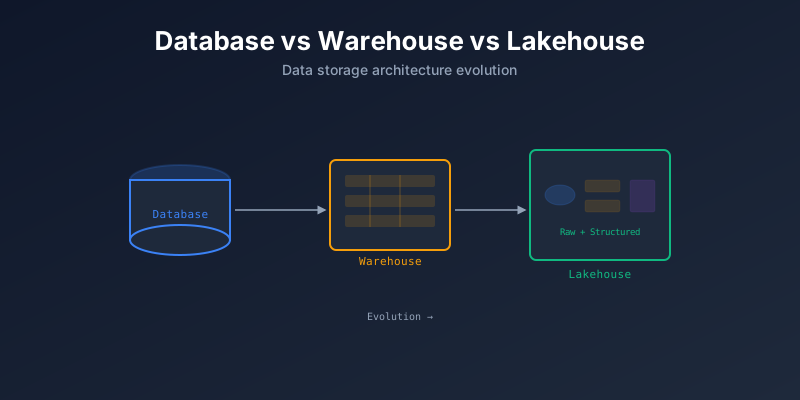
Database vs Data Warehouse vs Data Lakehouse
A clear comparison of databases, data warehouses, data lakes, and data lakehouses — when to use each one.
Understanding the differences between databases, data warehouses, data lakes, and data lakehouses is fundamental for data architecture.
Quick Comparison
| Feature | Database | Data Warehouse | Data Lake | Data Lakehouse |
|---|---|---|---|---|
| Purpose | Run applications | Business analytics | Store raw data | Both analytics + raw |
| Data type | Structured | Structured | Any (raw) | Any (governed) |
| Schema | Schema-on-write | Schema-on-write | Schema-on-read | Schema-on-read/write |
| Users | Developers | Analysts, BI | Data engineers, scientists | Everyone |
| Queries | OLTP (fast, small) | OLAP (complex, large) | Varies | OLAP + ML |
| Cost | Medium | High | Low | Medium |
Database (OLTP)
For running applications. Optimized for transactions — fast reads and writes of individual records.
App ──→ INSERT INTO orders VALUES (...)
App ──→ SELECT * FROM orders WHERE id = 123
App ──→ UPDATE orders SET status = 'shipped' WHERE id = 123
Examples: PostgreSQL, MySQL, MongoDB, DynamoDB
Characteristics:
- Row-oriented storage
- ACID transactions
- Low latency (milliseconds)
- Current state of data
Data Warehouse (OLAP)
For business analytics. Optimized for complex queries across large datasets.
Analyst ──→ SELECT region, SUM(revenue), AVG(order_value)
            FROM fact_sales
            JOIN dim_date ON ...
            WHERE year = 2025
            GROUP BY region
Examples: Snowflake, BigQuery, Redshift, Azure Synapse
Characteristics:
- Column-oriented storage (fast aggregations)
- Structured data with schema enforcement
- Historical data (months/years)
- ETL/ELT to load data
- Expensive for large volumes
Data Lake
A centralized repository for all raw data — structured, semi-structured, and unstructured.
Data Lake (S3, ADLS, GCS)
├── raw/
│   ├── logs/          ← JSON files
│   ├── images/        ← PNG, JPEG
│   ├── csv_exports/   ← CSV files
│   └── events/        ← Parquet files
├── processed/
│   └── cleaned_data/
└── curated/
    └── ready_for_analytics/
Examples: AWS S3, Azure Data Lake Storage, Google Cloud Storage
Characteristics:
- Store everything cheaply
- Schema-on-read (define schema when you query)
- Good for data science and ML
- Risk of becoming a “data swamp” without governance
Data Lakehouse
Combines the best of data lakes and data warehouses.
┌─────────────────────────────────────┐
│         Data Lakehouse              │
│                                     │
│  ┌─────────────────────────────┐   │
│  │  Metadata / Governance Layer │   │ ← ACID, Schema, Quality
│  └─────────────────────────────┘   │
│  ┌─────────────────────────────┐   │
│  │  Open File Formats          │   │ ← Parquet, Delta, Iceberg
│  └─────────────────────────────┘   │
│  ┌─────────────────────────────┐   │
│  │  Cheap Object Storage       │   │ ← S3, ADLS, GCS
│  └─────────────────────────────┘   │
└─────────────────────────────────────┘
Examples: Databricks (Delta Lake), Apache Iceberg, Apache Hudi
Key features:
- ACID transactions on a data lake
- Schema enforcement and evolution
- Time travel (query historical versions)
- Works for both BI and ML
- Uses open file formats (Parquet, Delta, Iceberg)
- Cheaper than a data warehouse
Architecture Evolution
2000s: Database → ETL → Data Warehouse → BI Reports

2010s: Database → Data Lake → Data Warehouse → BI Reports
                      └──→ ML / Data Science

2020s: Database → Data Lakehouse → BI Reports
                       └──→ ML / Data Science
                       └──→ Real-time Analytics
When to Use What
| Scenario | Solution |
|---|---|
| Web/mobile app backend | Database (PostgreSQL, MySQL) |
| Business dashboards and KPIs | Data Warehouse (Snowflake, BigQuery) |
| Store all raw data cheaply | Data Lake (S3, ADLS) |
| BI + ML on same data | Data Lakehouse (Databricks, Iceberg) |
| Real-time analytics | Streaming + Lakehouse |
Summary
| Architecture | Best For | Trade-off |
|---|---|---|
| Database | Transactions, applications | Not for analytics |
| Data Warehouse | BI, reporting | Expensive, structured only |
| Data Lake | Cheap storage, ML | Can become messy |
| Data Lakehouse | Best of both worlds | Newer, ecosystem still maturing |