31 May 2026
Deep Learning: CNNs, RNNs, and Transfer Learning
How to build neural networks with PyTorch, understand backpropagation, and use transfer learning for practical results.
Deep learning uses neural networks with many layers to learn complex patterns from data.
Neural Network Basics
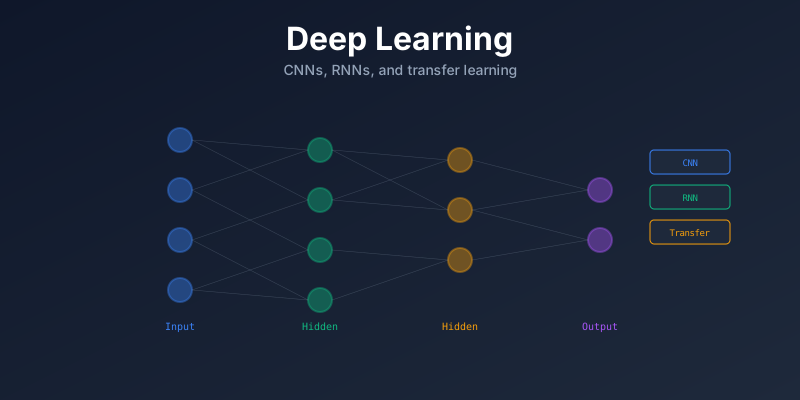
Input Layer    Hidden Layers    Output Layer
  [x1] ─────→  [h1] ─────→
  [x2] ─────→  [h2] ─────→    [output]
  [x3] ─────→  [h3] ─────→
Each connection has a weight. Each neuron applies:
$$output = activation(weights \cdot inputs + bias)$$
Common Activation Functions
| Function | Formula | Use Case |
|---|---|---|
| ReLU | max(0, x) | Hidden layers (default) |
| Sigmoid | 1/(1+e⁻ˣ) | Binary output |
| Softmax | eˣᵢ/Σeˣ | Multi-class output |
| Tanh | (eˣ-e⁻ˣ)/(eˣ+e⁻ˣ) | Hidden layers |
Backpropagation
How neural networks learn:
1. Forward pass  → compute prediction
2. Loss function → measure error
3. Backward pass → compute gradients (chain rule)
4. Update weights → gradient descent
↻ Repeat for many epochs
Loss functions:
- MSE — regression
- Cross-Entropy — classification
- Binary Cross-Entropy — binary classification
PyTorch Basics
import torch
import torch.nn as nn
import torch.optim as optim

# Define model
class SimpleNet(nn.Module):
    def __init__(self):
        super().__init__()
        self.fc1 = nn.Linear(784, 128)
        self.fc2 = nn.Linear(128, 64)
        self.fc3 = nn.Linear(64, 10)
        self.relu = nn.ReLU()

    def forward(self, x):
        x = self.relu(self.fc1(x))
        x = self.relu(self.fc2(x))
        x = self.fc3(x)
        return x

# Train
model = SimpleNet()
criterion = nn.CrossEntropyLoss()
optimizer = optim.Adam(model.parameters(), lr=0.001)

for epoch in range(10):
    for inputs, labels in train_loader:
        optimizer.zero_grad()
        outputs = model(inputs)
        loss = criterion(outputs, labels)
        loss.backward()      # backpropagation
        optimizer.step()     # update weights
CNNs — Convolutional Neural Networks
Best for images. They detect patterns like edges, shapes, and objects.
Image → [Conv + ReLU] → [Pool] → [Conv + ReLU] → [Pool] → [Flatten] → [FC] → OutputKey Layers
| Layer | What It Does |
|---|---|
| Conv2d | Applies filters to detect features |
| MaxPool2d | Reduces size, keeps important features |
| Flatten | Converts 2D to 1D for classification |
| Linear | Fully connected layer for final prediction |
class CNN(nn.Module):
    def __init__(self):
        super().__init__()
        self.conv1 = nn.Conv2d(1, 32, kernel_size=3)
        self.conv2 = nn.Conv2d(32, 64, kernel_size=3)
        self.pool = nn.MaxPool2d(2)
        self.fc1 = nn.Linear(64 * 5 * 5, 128)
        self.fc2 = nn.Linear(128, 10)

    def forward(self, x):
        x = self.pool(torch.relu(self.conv1(x)))
        x = self.pool(torch.relu(self.conv2(x)))
        x = x.view(x.size(0), -1)  # flatten
        x = torch.relu(self.fc1(x))
        return self.fc2(x)
Use cases: Image classification, object detection, medical imaging.
RNNs — Recurrent Neural Networks
Best for sequences (text, time series). They have memory of previous inputs.
x₁ → [RNN] → h₁
       ↓
x₂ → [RNN] → h₂
       ↓
x₃ → [RNN] → h₃ → output
LSTM — Long Short-Term Memory
Solves the vanishing gradient problem in basic RNNs.
class LSTMModel(nn.Module):
    def __init__(self, input_size, hidden_size, num_classes):
        super().__init__()
        self.lstm = nn.LSTM(input_size, hidden_size, batch_first=True)
        self.fc = nn.Linear(hidden_size, num_classes)

    def forward(self, x):
        out, (h_n, c_n) = self.lstm(x)
        out = self.fc(out[:, -1, :])  # last time step
        return out
Use cases: Text generation, sentiment analysis, time series forecasting.
Transfer Learning
Use a model pre-trained on large datasets and fine-tune it for your task.
Pre-trained model (ImageNet)
├── Feature layers ← FREEZE (keep)
└── Classification layer ← REPLACE (train)
import torchvision.models as models
# Load pre-trained ResNet
model = models.resnet18(pretrained=True)
# Freeze all layers
for param in model.parameters():
param.requires_grad = False
# Replace last layer
model.fc = nn.Linear(512, num_classes)
# Train only the new layer
optimizer = optim.Adam(model.fc.parameters(), lr=0.001)Why it works:
- Pre-trained models already know how to detect edges, shapes, textures
- You only need a small dataset for your specific task
- Much faster than training from scratch
Framework Comparison
| Feature | PyTorch | TensorFlow |
|---|---|---|
| Style | Pythonic, dynamic | Graph-based, static (v1) / eager (v2) |
| Debugging | Easy (standard Python) | Harder |
| Research | Preferred | Also used |
| Production | TorchServe, ONNX | TF Serving, TF Lite |
| Community | Growing fast | Large ecosystem |
Summary
| Architecture | Best For | Key Idea |
|---|---|---|
| Feed-forward | Tabular data | Layers of connected neurons |
| CNN | Images | Convolutional filters detect features |
| RNN/LSTM | Sequences | Memory of previous inputs |
| Transfer Learning | Small datasets | Reuse pre-trained knowledge |