31 May 2026
Domain Driven Design (DDD)
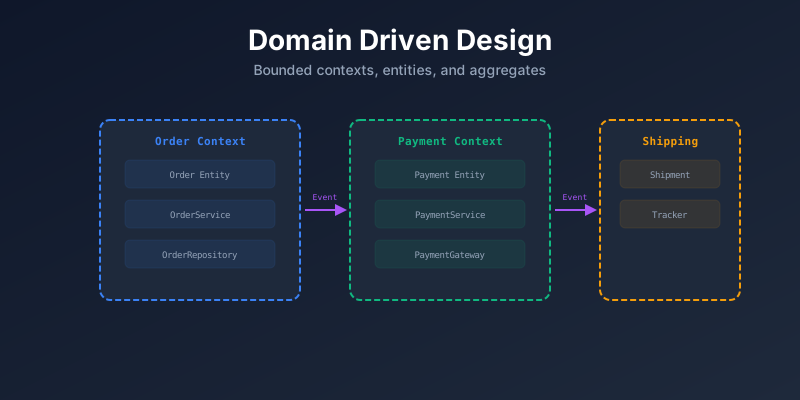
An overview of Domain Driven Design — bounded contexts, aggregates, entities, value objects, and how to organize complex software around the business domain.
Domain Driven Design (DDD) is an approach to building software that focuses on the business domain. The code should reflect how the business works.
Core Idea
“The structure of the code should match the structure of the business.”
Traditional approach: organize by technology (controllers, services, repositories). DDD approach: organize by domain (orders, payments, inventory).
Traditional:                     DDD:
├── controllers/                 ├── orders/
│   ├── OrderController          │   ├── Order.ts (entity)
│   ├── PaymentController        │   ├── OrderService.ts
│   └── InventoryController      │   └── OrderRepository.ts
├── services/                    ├── payments/
│   ├── OrderService             │   ├── Payment.ts
│   └── PaymentService           │   ├── PaymentService.ts
└── repositories/                │   └── PaymentRepository.ts
    ├── OrderRepository          └── inventory/
    └── PaymentRepository            ├── Product.ts
                                     └── InventoryService.ts
Strategic Design
Bounded Context
A bounded context is a boundary where a model has a specific meaning. The same word can mean different things in different contexts.
┌─────────────────┐    ┌─────────────────┐
│  Sales Context   │    │  Shipping Context│
│                  │    │                  │
│  "Customer" =    │    │  "Customer" =    │
│  name, email,    │    │  name, address,  │
│  payment info    │    │  delivery prefs  │
│                  │    │                  │
│  "Order" =       │    │  "Order" =       │
│  items, price    │    │  weight, route   │
└────────┬─────────┘    └────────┬─────────┘
         │    Shared: order_id   │
         └───────────────────────┘
Rule: Each bounded context has its own model, its own code, and its own database.
Ubiquitous Language
The same language used by developers and business people within a bounded context.
| Instead of | Use (if the business says) |
|---|---|
user_record | Customer |
item_list | Cart |
process_transaction | PlaceOrder |
status_flag | OrderStatus |
Tactical Design
Building Blocks
┌─────────────────────────────────────────┐
│            Aggregate Root               │
│  ┌──────────┐  ┌──────────────────────┐ │
│  │  Entity   │  │    Value Object      │ │
│  │  (Order)  │  │    (Money, Address)  │ │
│  └──────────┘  └──────────────────────┘ │
│  ┌──────────────────────────────────┐   │
│  │       Domain Events              │   │
│  │  (OrderPlaced, OrderShipped)     │   │
│  └──────────────────────────────────┘   │
└─────────────────────────────────────────┘
Entity
Has a unique identity. Two entities with the same data but different IDs are different.
class Order:
    def __init__(self, order_id: str, customer_id: str):
        self.id = order_id            # identity
        self.customer_id = customer_id
        self.items = []
        self.status = "created"

    def add_item(self, product_id: str, quantity: int, price: float):
        self.items.append(OrderItem(product_id, quantity, price))

    def place(self):
        if not self.items:
            raise ValueError("Cannot place empty order")
        self.status = "placed"
Value Object
No identity. Defined by its attributes. Two value objects with the same data are equal.
class Money:
    def __init__(self, amount: float, currency: str):
        self.amount = amount
        self.currency = currency

    def add(self, other: "Money") -> "Money":
        if self.currency != other.currency:
            raise ValueError("Cannot add different currencies")
        return Money(self.amount + other.amount, self.currency)

    def __eq__(self, other):
        return self.amount == other.amount and self.currency == other.currency
Aggregate
A cluster of entities and value objects treated as a single unit. Has one aggregate root that controls access.
Order (Aggregate Root)
├── OrderItem (Entity)
│   └── Money (Value Object)
├── ShippingAddress (Value Object)
└── OrderStatus (Value Object)

Rules:
- Access OrderItems ONLY through Order
- Save/load the entire Order at once
- Other aggregates reference Order by ID only
Domain Event
Something important that happened in the domain:
class OrderPlaced:
    def __init__(self, order_id: str, customer_id: str, total: Money):
        self.order_id = order_id
        self.customer_id = customer_id
        self.total = total
        self.occurred_at = datetime.now()
Events connect bounded contexts without tight coupling:
Sales Context                    Shipping Context
OrderPlaced ──→ event bus ──→ CreateShipment
Repository
Provides access to aggregates. Hides the database details.
class OrderRepository:
    def find_by_id(self, order_id: str) -> Order: ...
    def save(self, order: Order) -> None: ...
    def find_by_customer(self, customer_id: str) -> list[Order]: ...
Domain Service
Business logic that doesn’t belong to a single entity:
class PricingService:
    def calculate_total(self, order: Order, discounts: list) -> Money:
        # Logic involving multiple aggregates
        ...
Context Mapping
How bounded contexts relate to each other:
| Pattern | Description |
|---|---|
| Shared Kernel | Two contexts share a small common model |
| Customer-Supplier | One context provides, another consumes |
| Anti-Corruption Layer | Translate between contexts to protect your model |
| Open Host Service | Public API for others to consume |
| Published Language | Standard format for communication (JSON, Protobuf) |
┌──────────┐  Anti-Corruption  ┌──────────┐
│  Your    │◄── Layer ────────►│ External │
│  Context │   (translator)    │  System  │
└──────────┘                   └──────────┘
Summary
| Concept | Key Idea |
|---|---|
| Bounded Context | A boundary where terms have specific meaning |
| Ubiquitous Language | Shared vocabulary between dev and business |
| Entity | Has identity (Order, Customer) |
| Value Object | No identity, defined by attributes (Money, Address) |
| Aggregate | Cluster treated as one unit, one root |
| Domain Event | Something that happened (OrderPlaced) |
| Repository | Data access for aggregates |
| Context Map | How bounded contexts relate |