2 January 2026
Face2Sprite: Turning Faces into Pixel Art Characters
A hackathon project that converts face photographs into retro-style pixel art sprites for video games using image processing techniques.
Projects
Hackathon Python Image Processing
The Idea
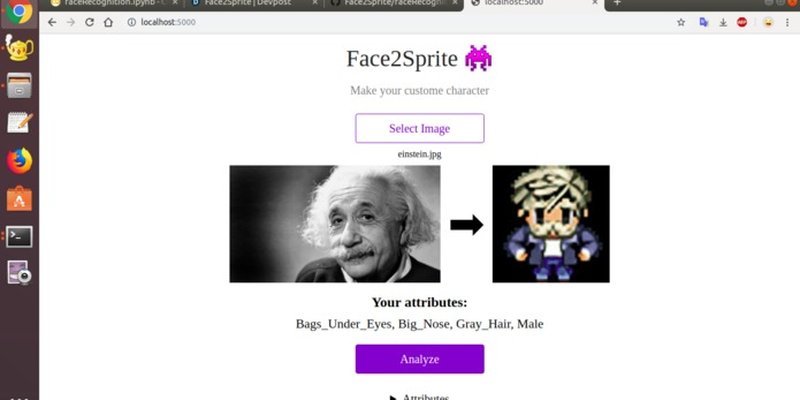
During a hackathon, my team and I built Face2Sprite — a tool that takes a photograph of someone’s face and generates a pixel art sprite suitable for retro-style video games.
The concept was simple: what if you could turn yourself (or your friends) into playable characters in a matter of seconds?
How It Works
The pipeline has three main stages:
- Face Detection — We detect and crop the face from the input image using OpenCV’s Haar cascades.
- Feature Extraction — Key facial features (eyes, nose, mouth, hair color, skin tone) are identified and mapped to sprite attributes.
- Sprite Generation — Based on the extracted features, we select and combine pre-drawn pixel art components to assemble a final sprite sheet.
import cv2

# Detect face in the image
face_cascade = cv2.CascadeClassifier('haarcascade_frontalface_default.xml')
gray = cv2.cvtColor(image, cv2.COLOR_BGR2GRAY)
faces = face_cascade.detectMultiScale(gray, 1.3, 5)
The Hackathon Experience
Building this in a limited timeframe forced us to make pragmatic decisions:
- We used a template-based approach for sprite generation rather than training a neural network — faster to implement and more predictable results.
- The sprite components were hand-drawn in a 16x16 pixel grid, giving that authentic retro feel.
- We focused on getting the core pipeline working end-to-end rather than perfecting any single step.
What I Learned
- Rapid prototyping is a skill in itself — knowing when “good enough” is the right answer.
- Image processing fundamentals (color spaces, edge detection, feature matching) are incredibly useful even in the age of deep learning.
- Working under time pressure with a team teaches you to communicate scope and trade-offs quickly.
Try It
The project is open source: Face2Sprite on GitHub