31 May 2026
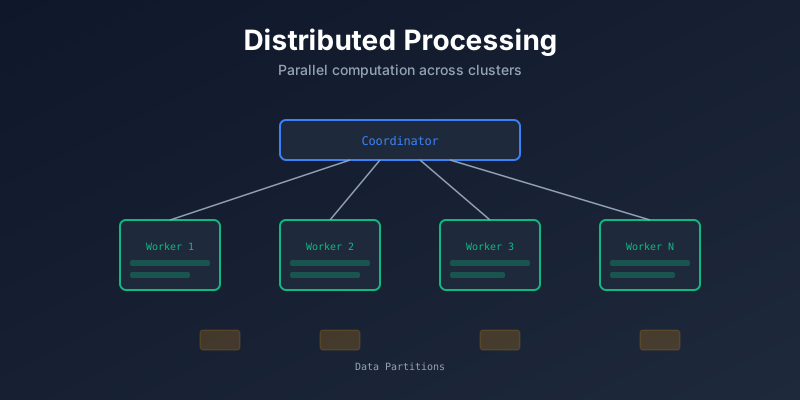
Distributed Processing
Key concepts of distributed systems, how data is processed across multiple machines, and common patterns.
Distributed processing splits work across multiple machines to handle data too large for a single computer.
Why Distributed?
- Scale — process terabytes/petabytes of data
- Speed — parallel processing is faster
- Reliability — if one machine fails, others continue
- Cost — many cheap machines vs one expensive one
Key Concepts
Vertical vs Horizontal Scaling
Vertical (Scale Up)          Horizontal (Scale Out)
┌────────────────┐          ┌──────┐ ┌──────┐ ┌──────┐
│  BIG Machine   │          │Small │ │Small │ │Small │
│  More CPU      │          │Node 1│ │Node 2│ │Node 3│
│  More RAM      │          └──────┘ └──────┘ └──────┘
│  More Storage  │
└────────────────┘          ← Distributed processing does this
CAP Theorem
A distributed system can only guarantee two of three:
| Property | Meaning |
|---|---|
| Consistency | All nodes see the same data |
| Availability | Every request gets a response |
| Partition tolerance | System works despite network failures |
In practice, network partitions happen, so you choose between CP (consistent) or AP (available).
MapReduce
The classic pattern for distributed data processing:
         ┌──→ Map (Node 1) ──→ Shuffle ──→ Reduce (Node A) ──┐
Data ────┼──→ Map (Node 2) ──→ Shuffle ──→ Reduce (Node B) ──┼──→ Result
└──→ Map (Node 3) ──→ Shuffle ──→ Reduce (Node C) ──┘- Map — process each piece of data independently
- Shuffle — group results by key
- Reduce — aggregate grouped results
Partitioning (Sharding)
Split data across nodes:
Data: users
├── Shard 1: users A-M  → Node 1
└── Shard 2: users N-Z  → Node 2
Strategies:
- Hash-based:
hash(key) % num_shards - Range-based: alphabetical, by date
- Geographic: by region
Replication
Copy data across nodes for reliability:
Write ──→ Leader ──→ Follower 1
                 ──→ Follower 2
Read ←── any node
Common Patterns
Batch Processing
Process large datasets at scheduled times.
Raw Data (HDFS/S3) → Process (Spark/MapReduce) → Results (DB/Files)
                     (runs overnight)
Tools: Apache Spark, Hadoop MapReduce, AWS EMR
Stream Processing
Process data in real-time as it arrives.
Events → Message Queue → Process → Output
         (Kafka)         (Flink)   (DB/Dashboard)
Tools: Apache Kafka, Apache Flink, Spark Streaming
Lambda Architecture
Combine batch and stream processing:
                ┌── Batch Layer (Spark) ──→ Batch Views
Data Source ────┤
                └── Speed Layer (Flink) ──→ Real-time Views
                                                │
                                          Serving Layer
                                          (merge both)
Distributed Consensus
How nodes agree on values (leader election, distributed locks):
- Raft — understandable consensus algorithm
- Paxos — classic but complex
- ZooKeeper — coordination service
Summary
| Concept | Key Idea |
|---|---|
| MapReduce | Split work → process → combine results |
| Sharding | Divide data across machines |
| Replication | Copy data for reliability |
| Batch | Process large data periodically |
| Streaming | Process data in real-time |
| CAP | Choose consistency or availability |