31 May 2026
MLOps: Taking Models to Production
How to deploy and maintain ML models in production using Docker, Kubernetes, CI/CD, and experiment tracking. The operational side is the real work.
Training a model is maybe 10% of the work. The other 90% is getting it to production and keeping it running. This is MLOps.
The Reality of ML in Production
┌─────────────────────────────────────────────────────┐
│                  ML System in Production            │
│                                                     │
│  ┌──────────┐  Only a small fraction is the model   │
│  │ ML Code  │                                       │
│  └──────────┘                                       │
│  ┌─────────────────────────────────────────────┐    │
│  │ Data Collection, Verification, Feature       │    │
│  │ Engineering, Config, Serving Infrastructure, │    │
│  │ Monitoring, Testing, Process Management...   │    │
│  └─────────────────────────────────────────────┘    │
└─────────────────────────────────────────────────────┘
MLOps Lifecycle
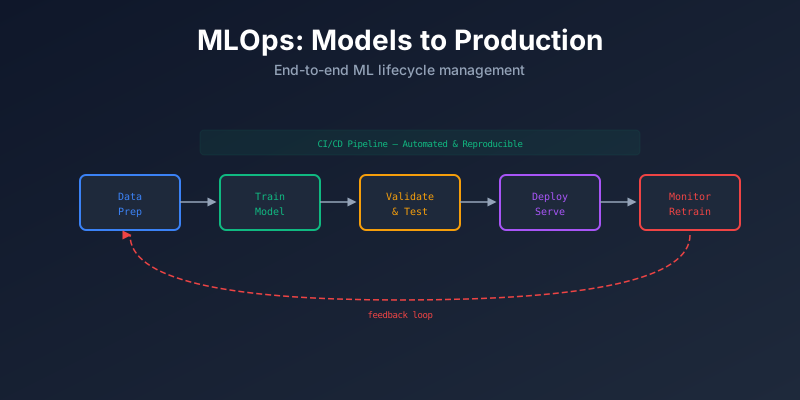
Data → Feature Eng → Train → Evaluate → Package → Deploy → Monitor
  ↑                                                           │
  └───────────────────── Retrain ─────────────────────────────┘
1. Experiment Tracking
Track every training run so you can reproduce results.
What to track:
- Hyperparameters (learning rate, batch size, epochs)
- Metrics (accuracy, loss, F1)
- Dataset version
- Model artifacts
- Code version (git commit)
Tools: MLflow, Weights & Biases, Neptune, ClearML
import mlflow

with mlflow.start_run():
    mlflow.log_param("learning_rate", 0.01)
    mlflow.log_param("epochs", 100)
    mlflow.log_metric("accuracy", 0.95)
    mlflow.sklearn.log_model(model, "model")
2. Containerization with Docker
Package your model and all dependencies into a Docker container.
FROM python:3.11-slim

WORKDIR /app
COPY requirements.txt .
RUN pip install -r requirements.txt

COPY model/ ./model/
COPY serve.py .

EXPOSE 8000
CMD ["uvicorn", "serve:app", "--host", "0.0.0.0", "--port", "8000"]
Why Docker:
- Same environment everywhere (dev, staging, prod)
- No “works on my machine” problems
- Easy to scale and deploy
3. Model Serving
Expose your model as an API:
from fastapi import FastAPI
import joblib

app = FastAPI()
model = joblib.load("model/model.pkl")

@app.post("/predict")
def predict(data: dict):
    features = preprocess(data)
    prediction = model.predict([features])
    return {"prediction": prediction[0]}
Serving options:
- FastAPI / Flask (custom API)
- TensorFlow Serving
- Triton Inference Server
- Seldon Core
- BentoML
4. Kubernetes for Scaling
Deploy model containers on Kubernetes for auto-scaling:
apiVersion: apps/v1
kind: Deployment
metadata:
  name: ml-model
spec:
  replicas: 3
  selector:
    matchLabels:
      app: ml-model
  template:
    spec:
      containers:
      - name: model
        image: myregistry/ml-model:v1.2
        resources:
          requests:
            memory: "512Mi"
            cpu: "500m"
          limits:
            memory: "1Gi"
            cpu: "1000m"
        ports:
        - containerPort: 8000
Kubernetes gives you:
- Auto-scaling based on traffic
- Rolling updates (zero downtime deploys)
- Health checks and auto-restart
- Resource management (CPU, GPU, memory)
5. CI/CD for ML
Automate the pipeline from code change to deployment:
# .github/workflows/ml-pipeline.yml
name: ML Pipeline
on:
  push:
    branches: [main]

jobs:
  train-and-deploy:
    runs-on: ubuntu-latest
    steps:
      - uses: actions/checkout@v4
      - name: Train model
        run: python train.py
      - name: Run tests
        run: pytest tests/
      - name: Build Docker image
        run: docker build -t ml-model:${{ github.sha }} .
      - name: Push to registry
        run: docker push myregistry/ml-model:${{ github.sha }}
      - name: Deploy to K8s
        run: kubectl set image deployment/ml-model model=myregistry/ml-model:${{ github.sha }}
6. Model Monitoring
Models degrade over time. You must monitor:
| What to Monitor | Why |
|---|---|
| Data drift | Input data distribution changes |
| Model drift | Predictions become less accurate |
| Latency | Response time increases |
| Throughput | Requests per second |
| Error rate | Failed predictions |
Tools: Evidently AI, Whylabs, Prometheus + Grafana
7. Model Registry
Central place to store and version models:
Model Registry
├── fraud-detection
│   ├── v1.0 (archived)
│   ├── v1.1 (staging)
│   └── v1.2 (production) ← current
└── recommendation
    ├── v2.0 (production)
    └── v2.1 (staging)
Tools: MLflow Model Registry, SageMaker Model Registry, Vertex AI
MLOps Maturity Levels
| Level | Description |
|---|---|
| 0 | Manual everything — notebooks, manual deploys |
| 1 | Automated training pipeline |
| 2 | Automated training + CI/CD for deployment |
| 3 | Full automation + monitoring + auto-retraining |
Summary
The majority of ML work in production is not model development. It is:
- Building reliable data pipelines
- Packaging and deploying models
- Monitoring performance
- Automating retraining
- Managing infrastructure
MLOps makes this repeatable and reliable.